When the Lead Evaporates: What Late-Game Defensive Collapses Reveal About a Team's True Mental Makeup

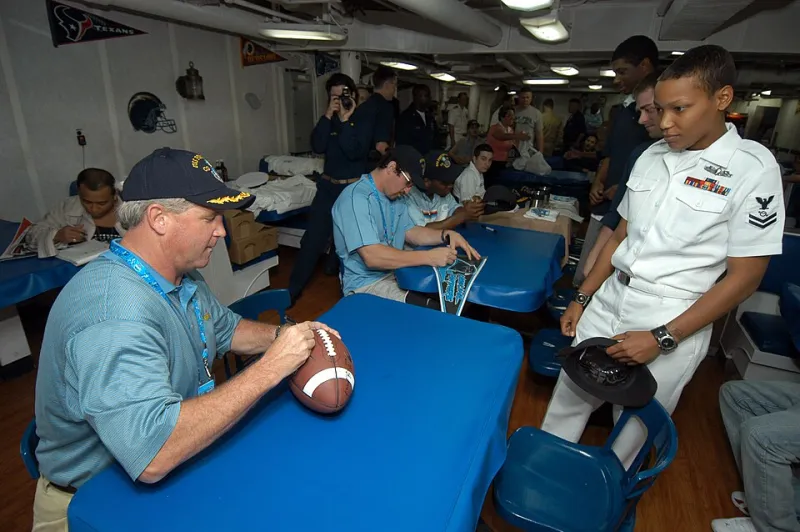
Photo: Mass Communication Specialist 2nd Class Brigitte Johnston, Public domain, via Wikimedia Commons
There's a specific kind of agony that comes with watching a comfortable lead dissolve in the final minutes of a football game. The offense goes into a shell. The crowd gets tight. And somewhere on that sideline, a defense that looked dominant for three quarters starts making decisions — mental and physical — that unravel everything built before halftime.
It happens more often than fans want to admit. And every time it does, the post-game analysis zeroes in on the wrong things: a busted coverage here, a missed tackle there. But the real story? It starts way earlier, and it runs a lot deeper than any single play.
The Anatomy of a Fourth-Quarter Meltdown
Let's be direct about something: no defense just spontaneously falls apart in the fourth quarter. The cracks are usually visible before they become craters. What changes late in games isn't necessarily the talent on the field — it's the posture of the unit.
When a team builds a 17-point lead heading into the final frame, something subtle shifts in how the defense approaches its job. Coordinators often dial back the aggression, dropping into softer zone coverages designed to prevent big plays rather than create stops. On paper, that's sound strategy. In practice, it can hand a desperate offense exactly the rhythm it needs.
Short completions turn into first downs. First downs turn into momentum. Momentum turns into points. And before anyone on the sideline fully registers what's happening, the cushion that felt safe ten minutes ago has shrunk to a possession game.
This is the part that separates elite defenses from average ones: the elite units recognize the shift and fight against it. The average ones lean into the comfort of a lead — and get burned.
Film Doesn't Lie: The Tactical Tells
Breaking down tape from recent high-profile collapses reveals a handful of recurring patterns. First, there's the coverage shell — the tendency to play every receiver as if they're a deep threat even when the offense clearly needs chunk yards in a hurry. Second, there's the pass-rush pullback, where edge rushers stop attacking and start containing, giving quarterbacks an extra half-second that might as well be a lifetime at the NFL level.
Then there's the most telling tell of all: pre-snap communication. In the first half of most games, defenses are loud, coordinated, and deliberate in their adjustments. Watch the same unit in a fourth-quarter scramble situation and you'll often see hesitation, late calls, and coverage mismatches that simply wouldn't happen when the defense is operating with full confidence.
It's not about physical fatigue — though that's a factor. It's about cognitive load. When a defense is protecting a lead rather than hunting a stop, the mental framework shifts. Players start thinking about not giving up the big play instead of making the big play. That's a losing mentality dressed up in conservative clothing.
The Coordinator's Dilemma
Defensive coordinators are often caught in an impossible-feeling bind late in close games. Go aggressive and risk getting torched over the top. Play soft and risk getting nickel-and-dimed down the field. The coordinators who consistently make the right call in those moments share one thing in common: they trust their players to execute instead of trying to scheme away the pressure.
The best late-game defenses aren't necessarily the ones running the most exotic looks. They're the ones that can line up in a base coverage, communicate clearly, and execute fundamentals under duress. Simplicity under pressure is a skill — and it's one that takes intentional practice to develop.
Coaches who've navigated successful fourth-quarter stands often talk about the importance of reset moments — brief timeouts or dead balls where the entire unit can recalibrate, breathe, and remind themselves of the assignment. It sounds almost too simple. But when adrenaline is spiking and the crowd is going sideways, that kind of deliberate mental reset is the difference between a clean rep and a busted coverage that ends up on a highlight reel for all the wrong reasons.
Case Study: When Elite Defenses Hold the Line
Think back to some of the most memorable defensive stands in recent playoff history. What made them work wasn't complexity — it was conviction. Units that held on in those moments were playing fast, communicating early, and trusting their preparation. They weren't guessing. They weren't reacting. They were executing.
Contrast that with some of the most stunning collapses in recent memory — games where teams with legitimate defensive talent gave up 21 unanswered points in under eight minutes. In almost every case, the breakdown wasn't one catastrophic mistake. It was a sequence of small compromises: a soft coverage that gave up six yards instead of zero, a missed gap assignment that turned a two-yard gain into a twelve-yard pickup, a quarterback who suddenly had all day to throw because the pass rush evaporated.
Those small compromises don't happen in isolation. They're symptoms of a defense that's mentally playing not to lose instead of playing to win.
Building Defenses That Don't Flinch
So what actually separates the units that close games from the ones that give them away? A few things stand out consistently:
Accountability culture. The best defenses have players who hold each other to a standard in the moment — not after the fact. A linebacker who immediately corrects a safety's alignment before the snap, a corner who communicates a route concept to his help — those micro-adjustments happen because the culture demands them.
Situational reps in practice. Teams that simulate fourth-quarter pressure during the week — running two-minute drill defenses against their own offense in high-stakes practice settings — are better equipped to handle the real thing. Stress inoculation works. The brain handles familiar pressure better than novel pressure.
Coaching stability. Defenses with consistent coordinators and systems tend to hold up better late in games because the players aren't processing new information under duress. They're executing a language they know fluently.
Every Play Matters — Especially the Last Ones
Here's the thing about fourth-quarter leads: they're earned. A team that builds a 17-point advantage has done something right for three quarters. But football has a brutal way of resetting the narrative based on what happens in the final minutes, not the first three frames.
The defenses that understand this — that treat the last drive of a game with the same urgency and attention as the first — are the ones you'll find playing deep into January. The ones that don't? They end up as cautionary tales, studied in film rooms and written about in exactly this kind of breakdown.
Every play matters. Especially when the clock is winding down and the lead is shrinking. That's not a cliché — it's the entire game.